Introduction: What is Local SEO for LLMs?
Local SEO for LLMs is rapidly emerging as a new discipline at the intersection of traditional search engine optimization and artificial intelligence–driven discovery. As large language models like ChatGPT, Gemini, and Claude become primary tools for finding information, businesses must rethink how local visibility works in an AI-first world. Earlier, local SEO focused mainly on ranking in Google Maps, local packs, and organic search results. Today, LLMs synthesize information from multiple sources to answer user queries directly, which means local businesses are no longer competing only for rankings, but for inclusion in AI-generated responses. Understanding how LLMs interpret, evaluate, and present local data is essential for future-proofing local SEO strategies.
At its core, local SEO for LLMs is about ensuring that AI systems can confidently recognize a business as relevant, trustworthy, and geographically accurate. LLMs do not crawl the web in real time like search engines; instead, they rely on training data, structured signals, authoritative sources, and real-time plugins or APIs when available. This changes the optimization mindset from keyword stuffing and backlinks to clarity, consistency, and entity-based optimization. Businesses must communicate who they are, where they operate, and what they offer in a way that machines can easily understand and verify across the web.
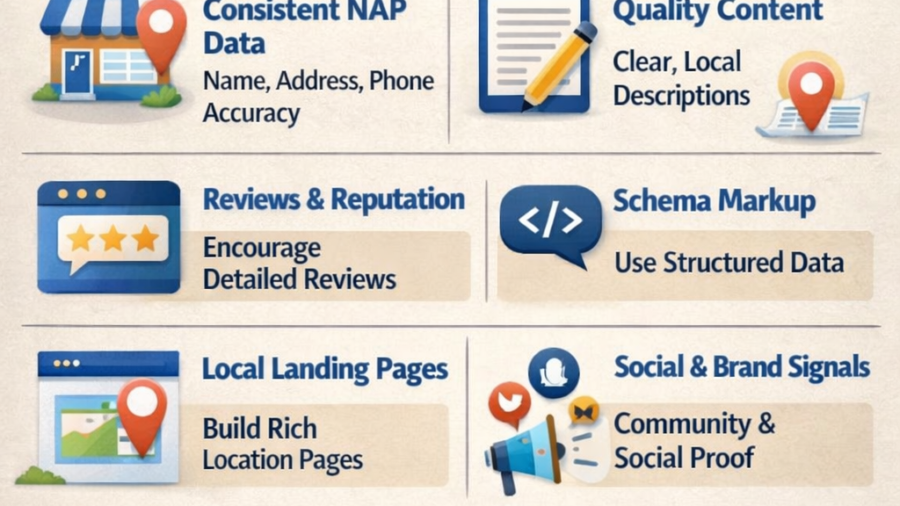
One of the most important foundations of local SEO for LLMs is entity recognition. LLMs work by understanding entities such as businesses, locations, services, and brands, and then mapping relationships between them. If a business’s name, address, phone number, and category are inconsistent across platforms, it weakens the AI’s confidence in that entity. Consistent NAP data across Google Business Profile, Bing Places, Apple Maps, Yelp, social platforms, and local directories creates a strong entity footprint. When an LLM sees the same information repeated across authoritative sources, it is more likely to include that business in its responses to local queries.
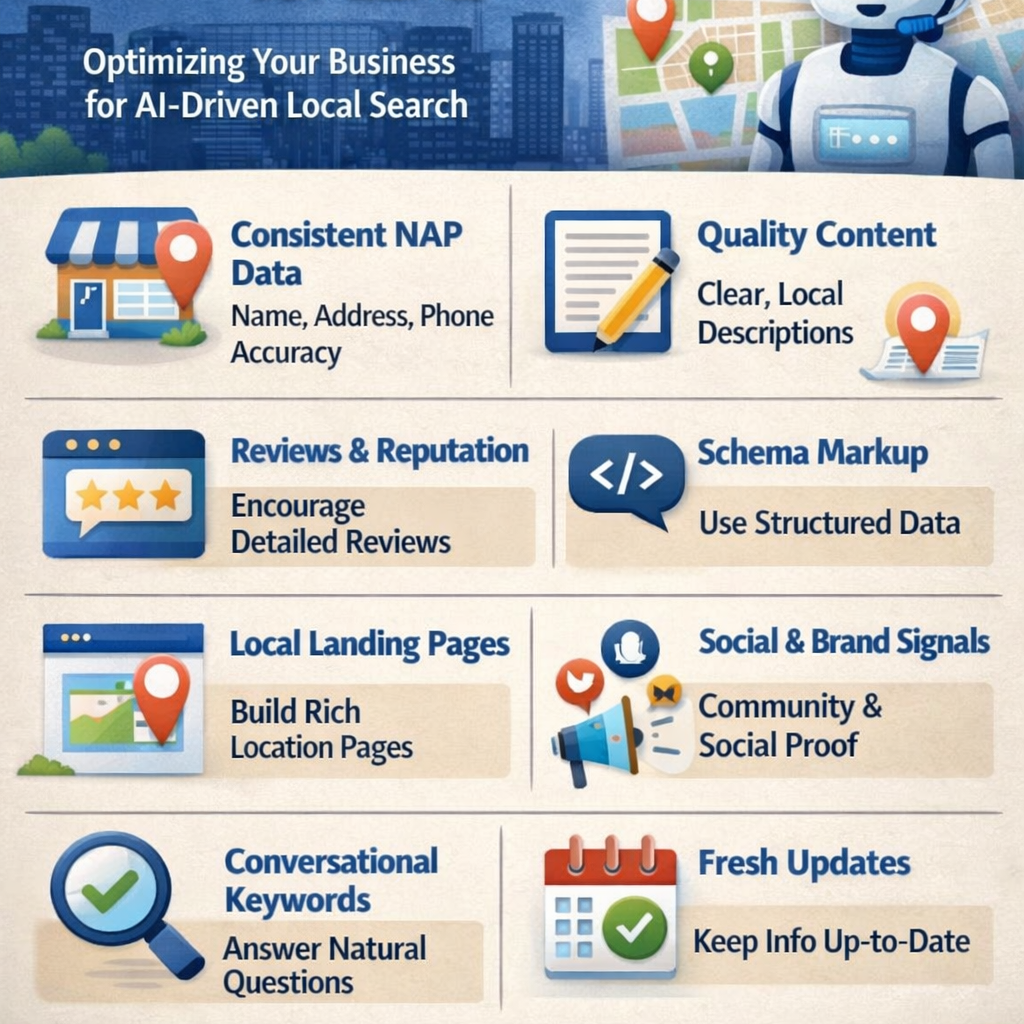
Another critical factor is the quality of business descriptions and contextual content. LLMs are designed to understand natural language, not just keywords. Local businesses should invest in well-written, human-focused descriptions on their websites and profiles that clearly explain services, service areas, and unique value propositions. Instead of listing generic phrases like “best service provider,” content should describe real-world use cases, neighborhoods served, customer problems solved, and local relevance. This narrative-style content aligns perfectly with how LLMs process and generate responses, increasing the chances of being cited or summarized by AI tools.
Reviews and reputation signals play an expanded role in local SEO for LLMs. Traditional search engines use reviews as ranking factors, but LLMs treat reviews as qualitative data that helps shape recommendations. A business with a large volume of authentic, descriptive reviews mentioning specific services and locations provides rich language data for AI models. When users ask an LLM for “the best plumber in South Delhi” or “a reliable café near Connaught Place,” the model is more likely to recommend businesses that have strong review signals with location-specific context. Encouraging customers to leave detailed, honest reviews, therefore, becomes an AI-visibility strategy, not just a trust-building exercise.
Structured data is another pillar that bridges local SEO and LLM understanding. Schema markup, such as LocalBusiness, Organization, Product, and Review schemas, helps define information in a machine-readable format. While LLMs do not rely solely on schema, structured data improves clarity and reduces ambiguity when AI systems parse web content. Adding accurate schema to location pages, contact pages, and service pages strengthens the business’s digital identity and supports better AI interpretation, especially when combined with consistent citations and authoritative backlinks.
Local content creation must also evolve for LLM optimization. Instead of writing thin city pages stuffed with keywords, businesses should publish meaningful local content that demonstrates expertise and community involvement. Articles about local events, guides, case studies, and partnerships signal a genuine local presence. LLMs value depth and relevance, so content that reflects real local knowledge is more likely to be trusted. For example, a restaurant writing about sourcing ingredients from nearby markets or a clinic explaining healthcare challenges in a specific area provides contextual signals that AI models can use when answering local queries.
Another often overlooked aspect of local SEO for LLMs is brand authority beyond search engines. LLMs draw information from a wide range of sources, including news websites, forums, Q&A platforms, and social media discussions. Mentions in local news, collaborations with recognized organizations, and participation in community initiatives help build a broader digital footprint. When a brand is discussed positively and consistently across the web, it increases the likelihood that LLMs will recognize it as a credible local authority.
Voice search and conversational queries further amplify the importance of LLM-focused local SEO. Many local searches are now phrased as natural questions, such as “Where can I find a good gym near me?” or “Which digital marketing agency in Jaipur is best for startups?” LLMs excel at answering these queries, but only if they have access to clear, conversational content. Optimizing FAQs, using question-based headings, and writing in a natural tone helps align website content with how people speak to AI assistants, improving local discoverability.
Accuracy and freshness of information are also critical challenges. Since LLMs may rely on cached or historical data, outdated business information can lead to incorrect recommendations. Regularly updating websites, business profiles, and directories ensures that real-time tools and AI-integrated search systems access the most current data. Posting updates, announcements, and new content signals activity and relevance, which are important trust indicators for both users and AI systems.
Trustworthiness, or what can be described as AI-level E-E-A-T, is becoming central to local SEO for LLMs. Experience, expertise, authoritativeness, and trustworthiness are not just search guidelines but essential qualities for AI recommendations. Highlighting real team members, showcasing credentials, displaying transparent contact information, and sharing genuine customer stories all contribute to a stronger trust profile. LLMs aim to reduce misinformation, so they tend to favor businesses with clear ownership, verifiable details, and a positive online reputation.
As AI-generated answers reduce the need for users to click through multiple search results, being “the answer” becomes more valuable than being ranked first. Local SEO for LLMs is therefore not about gaming algorithms, but about building a coherent, credible, and human-centered digital presence. Businesses that focus on clarity, consistency, and real local value will naturally align with how LLMs select and present information.
In the coming years, local SEO will continue to shift from keyword-driven tactics to entity-driven and context-driven optimization. LLMs will increasingly act as intermediaries between users and businesses, shaping discovery in subtle but powerful ways. Those who adapt early by optimizing for AI understanding, not just search engine rankings, will gain a significant competitive advantage. Local SEO for LLMs is not a replacement for traditional SEO, but an evolution that rewards authenticity, relevance, and genuine local engagement in an AI-powered world.
Finally, local SEO for LLMs represents a shift toward ethical and transparent optimization. Manipulative tactics, fake reviews, or misleading information may temporarily work in traditional SEO but are risky in AI-driven systems. LLMs are designed to detect patterns of misinformation and reduce exposure to unreliable sources. Businesses that focus on honest communication, real customer experiences, and accurate local data are better positioned for sustainable success.
Why You Need a New Local SEO AI Tool Stack
You need a new local SEO AI tool stack because local search is no longer limited to blue links, map packs, and directory rankings. The way people discover nearby businesses has shifted toward AI-driven experiences where answers are generated, not searched for. When users ask questions like “Which is the best clinic near me?” or “Find a trusted service provider in my area,” AI systems such as large language models, voice assistants, and AI-powered search interfaces decide what to recommend. Traditional SEO tools were designed to track rankings and keywords, but they are not equipped to measure how your business is understood, trusted, or surfaced by AI systems. This gap makes a new local SEO AI tool stack not just helpful, but necessary.
One of the biggest reasons a new tool stack is required is that AI systems operate on entity understanding rather than keyword matching. Older tools focus heavily on keyword positions and backlink counts, but AI evaluates businesses as entities with attributes like location, reputation, expertise, and consistency across the web. A modern AI-driven local SEO stack helps you monitor and manage these entity signals. It allows you to track name, address, and phone consistency, brand mentions, review sentiment, and contextual relevance, all of which directly influence how AI models interpret your business without tools that surface these insights.