Introduction: How to Rank at the Top of the Google Search Engine in a Real and Sustainable Way
Ranking at the top of the Google search engine is no longer about chasing tricks or manipulating algorithms. Google has evolved into a system that closely studies human behavior, intent, and satisfaction. Websites that rank well today do so because they genuinely help users, not because they follow shortcuts. Understanding this shift is the first step toward achieving long-term visibility in search results.
Google’s primary objective is simple: to deliver the most useful, trustworthy, and relevant answer for every search query. Everything else, including algorithms, updates, and ranking signals, exists to support that goal. If your website aligns with this purpose, ranking becomes a natural outcome rather than a constant struggle.
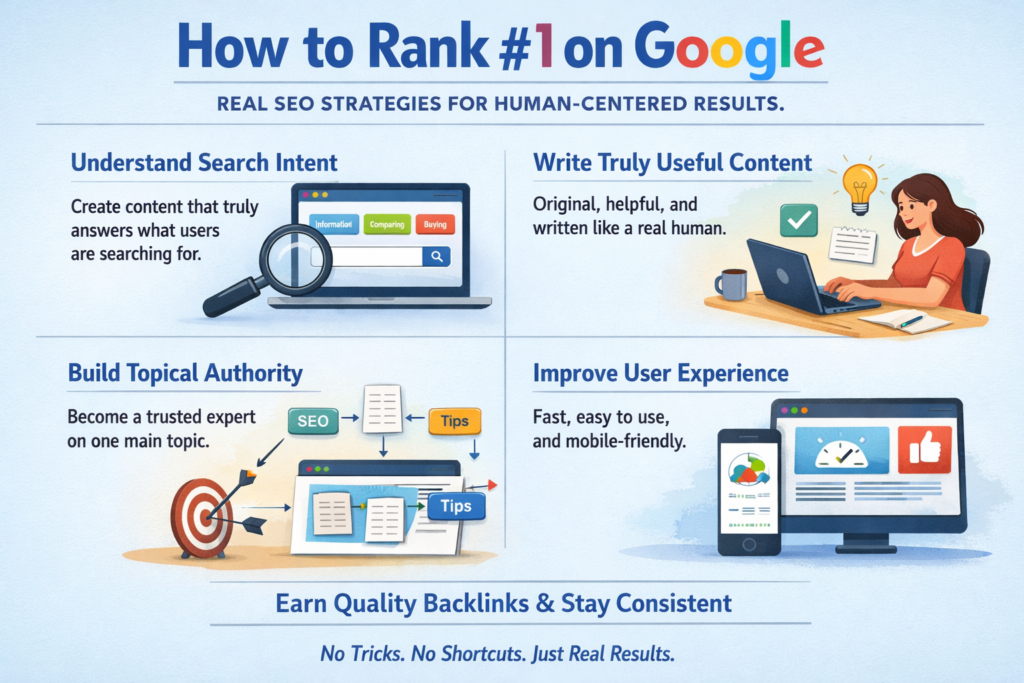
The foundation of ranking well on Google begins with understanding why people search in the first place. Every search carries an intent. Some users are looking for information, others want to compare options, and some are ready to take action. Google studies this intent by analyzing user behavior across millions of searches. If your content does not clearly match the intent behind a query, it will struggle to rank, regardless of how well it is written. Successful websites study the top-ranking pages for a keyword and understand what users expect to see when they search for it. Matching that expectation while offering deeper insight is what allows a page to move higher in results.
Keyword selection plays an important role, but it is often misunderstood. Many beginners focus on high-volume keywords, believing that more searches automatically mean more traffic. In reality, high-volume keywords are usually dominated by established websites with strong authority. A smarter approach is to focus on keywords that are specific, clear, and directly connected to user needs. These keywords may have lower search volume, but they attract users who are more engaged and easier to satisfy. Google notices when users stay on a page, read thoroughly, and do not return to search, and it rewards that behavior with better rankings.
Content quality is the most decisive factor in modern SEO. Google can now evaluate content far beyond keyword presence. It analyzes clarity, depth, originality, and usefulness. Thin content written only to target keywords rarely survives long in search results. High-ranking pages explain topics thoroughly, answer related questions naturally, and offer insights that feel earned through experience. Writing in a natural, conversational tone helps build trust, while over-optimized or robotic writing signals low value to both users and search engines.
Another critical element is topical authority. Google prefers to rank websites that consistently cover a subject in depth rather than those that publish random content across unrelated topics. When a website demonstrates clear expertise in a specific area, Google begins to trust it as a reliable source. This trust develops over time as more quality content is published around the same topic. As authority grows, new pages begin to rank faster and more easily because Google already recognizes the site’s relevance.
On-page optimization still matters, but it should never overpower the reading experience. Titles, descriptions, and headings should guide readers, not manipulate search engines. A strong title clearly communicates what the page is about and encourages clicks without exaggeration. The content beneath it should deliver exactly what the title promises. Internal links should feel helpful rather than forced, guiding users to related information and helping Google understand how different pages connect within your website.
User experience has become inseparable from rankings. Google measures how users interact with a website, including page load speed, mobile usability, and overall design clarity. A slow or cluttered website creates frustration, and frustrated users leave quickly. When this happens repeatedly, Google interprets it as a signal that the page is not satisfying search intent. Clean design, readable fonts, logical navigation, and fast loading times all contribute to better user engagement, which directly supports higher rankings.
Backlinks continue to influence rankings, but their role has changed significantly. Google is no longer impressed by large numbers of low-quality links. Instead, it values relevance and trust. A single mention from a respected website in your niche can carry more weight than dozens of unrelated links. Natural backlinks are usually earned through high-quality content, original research, and genuine collaboration. Attempts to manipulate backlinks through spammy methods often lead to ranking losses rather than gains.
Consistency is one of the most underrated factors in SEO success. Many websites fail not because they lack potential, but because their owners stop publishing too soon. Google builds trust gradually. A website that publishes valuable content consistently over months shows commitment and reliability. This steady effort signals to Google that the site is active, maintained, and worth ranking. SEO is not a quick process, but it becomes easier once trust is established.
Tracking performance helps refine strategy, but it is important to focus on meaningful data. Rankings alone do not tell the full story. Search impressions, click-through rates, and user engagement provide clearer insight into how Google views your content. Tools like Google Search Console reveal what queries your pages appear for and how users interact with them. Using this information to improve existing content is often more effective than constantly creating new pages.
One of the biggest mistakes website owners make is trying to please algorithms instead of people. Google’s systems are designed to imitate human judgment as closely as possible. Content that feels honest, useful, and thoughtfully written naturally aligns with what Google wants to rank. Over-optimization, keyword stuffing, and forced SEO techniques often work against this goal.
Patience plays a vital role in achieving top rankings. SEO progress is rarely immediate, especially for new websites. Early months are often quiet, with little visible traffic growth. However, each well-written article adds to your site’s credibility. Over time, these efforts compound, leading to stronger visibility and stable traffic. Those who remain consistent and focused usually outperform those chasing shortcuts.
In the end, ranking at the top of the Google search engine is about becoming the best answer available. It requires understanding your audience, creating content that genuinely helps them, and presenting it in a way that is easy to access and trust. Google rewards websites that respect users’ time and intelligence. When you prioritize real value over quick wins, rankings follow naturally, and they tend to last.