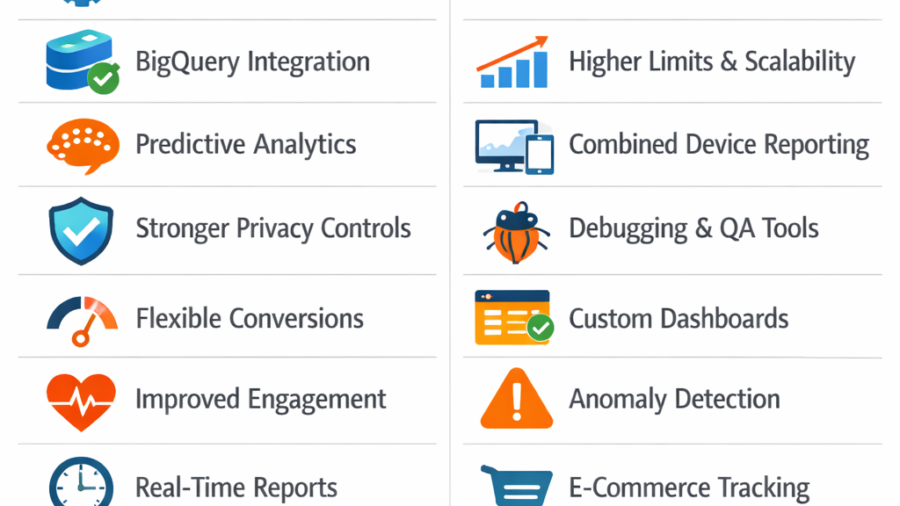
Top 22 Key Benefits of Google Analytics 4 (GA4)
Why GA4 Is the Future of Digital Analytics and a Must-Have for Modern Businesses
Google Analytics 4 (GA4) represents a significant evolution from the older Universal Analytics (UA). GA4 is a more intelligent, Top 22 Key Benefits of Google Analytics 4 (GA4) (flexible, privacy-focused, and future-ready platform designed to help businesses better understand customer journeys, optimize marketing performance, and make data-driven decisions. Below are the top 22 benefits that explain why GA4 is so essential in today’s analytics landscape:
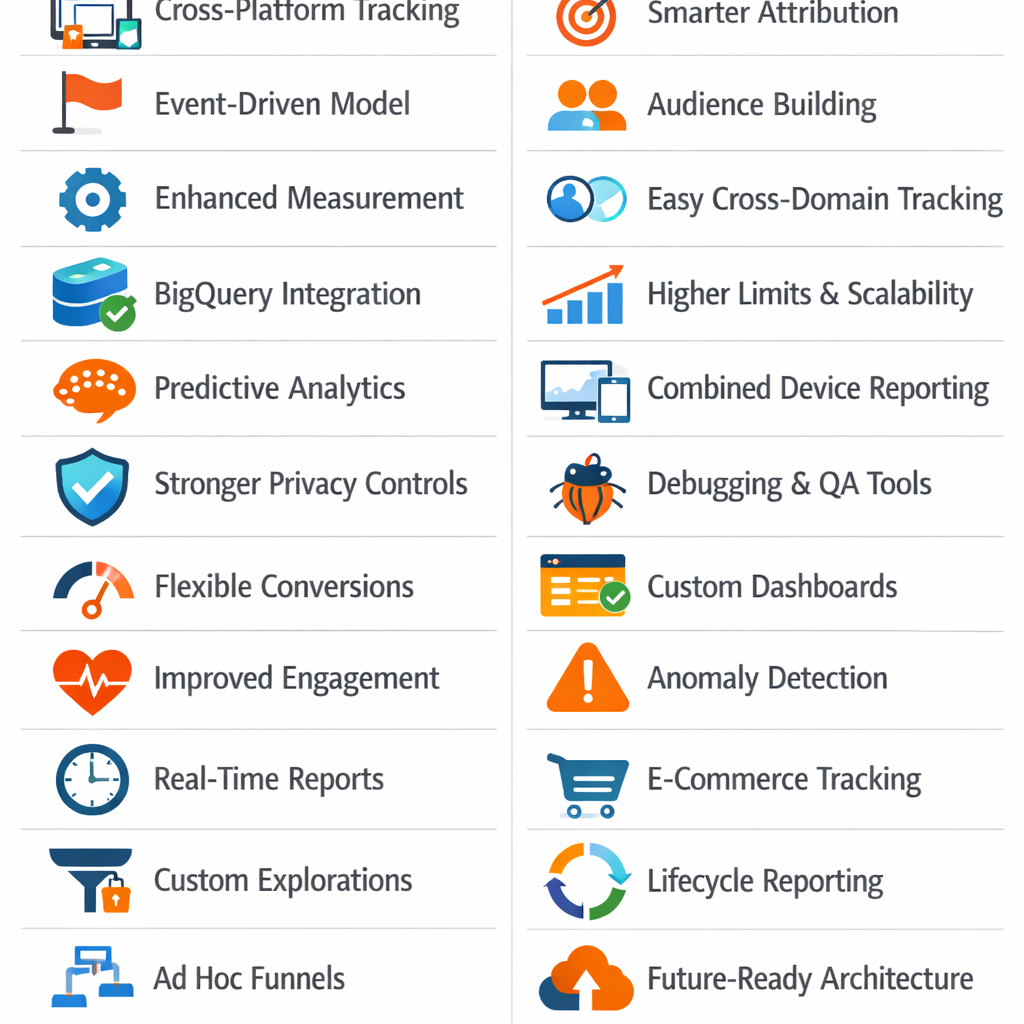
1. Unified App + Web Tracking (Cross-Platform Insight)
GA4 allows you to track user behavior across websites and mobile apps in one property, giving a holistic view of the customer journey — something Universal Analytics couldn’t do easily without complex integrations.
2. Event-Driven Data Model
Unlike Universal Analytics’ hit-based model (pageviews, sessions), GA4 treats everything as events, providing far more flexibility and granularity in tracking every interaction — clicks, scrolls, video plays, downloads, and more.
3. Enhanced Measurement Requires Less Manual Setup
GA4 can automatically track common interactions — such as scrolls, file downloads, outbound clicks, and video engagement — without requiring manual tagging, saving time for analytics teams.
4. Free Google BigQuery Integration
GA4 offers free native integration with BigQuery — previously available only in paid versions — allowing businesses to export raw data and perform deep SQL-level analysis and modeling.
5. Machine Learning & Predictive Insights
GA4 leverages built-in machine learning to fill gaps in data (especially in a cookie-less world), detect trends, and generate predictive metrics like purchase probability, churn probability, and predicted revenue.
6. Stronger Data Privacy & Compliance
GA4 is designed for a future without third-party cookies, offers enhanced privacy controls, and aligns with modern data protection laws (e.g., GDPR, CCPA) to strike a balance between insights and user privacy.
7. Flexible Conversion Tracking
Instead of limited goal types as in UA, GA4 lets you mark any event as a conversion, enabling more customized and flexible conversion tracking.
8. Improved Engagement Metrics
Traditional bounce rate is replaced with engagement metrics like engaged sessions and engagement time, offering more accurate insights into user behavior.
9. Real-Time Reporting Overhaul
GA4’s real-time reporting surfaces meaningful insights from the last 30 minutes in a unified view, making it easier to monitor and act on data quickly.
10. Custom Explorations for Deep Analysis
With features like Free Form, Funnels, and Path Analysis, GA4 allows analysts to explore data deeply without leaving the interface — previously available only in premium versions.
11. Ad Hoc Funnels
You can now create and modify funnels on the fly and analyze user behavior retrospectively — a powerful advantage for marketers analyzing conversion paths.
12. Dynamic Reporting Identity Options
GA4 lets you choose how users are identified (e.g., by device, User ID, Google Signals), improving accuracy in cross-device analysis.
13. Smarter Attribution Models
By default, GA4 uses data-driven attribution, which allocates credit across touchpoints more accurately than UA’s last-non-direct-click model.
14. Audience and Segmentation Flexibility
GA4 supports event-based audience creation with complex filters and time-based segmentation, enabling more precise targeting in marketing campaigns.
15. Simplified Cross-Domain Tracking
GA4 makes cross-domain tracking much easier — reducing the need for complicated setups and additional code adjustments.
16. Higher Limits & Scalability
GA4 supports unlimited events per session and higher counts for custom dimensions and audiences, offering better scalability for enterprise-level data needs.
17. Combined Reporting Across Devices
Since GA4 is user-centric (instead of session-based like UA), it paints a more accurate picture of users who switch between devices — critical for omnichannel business.
18. DebugView for Testing and QA
GA4 includes a DebugView that lets you check your tracking in real-time, ensuring that events and conversions fire exactly when expected.
19. Customizable Dashboards & Reports
GA4’s report library enables tailored dashboards, allowing businesses to focus on key KPI insights without navigating excessive defaults.
20. Data-Driven Alerts & Anomaly Detection
AI-powered insights and anomaly detection automatically flag significant data trends, helping analysts respond quickly to opportunities or issues.
21. Better E-Commerce Tracking & Lifecycle Reports
GA4 provides strong support for detailed e-commerce tracking and lifecycle reporting (acquisition → engagement → monetization → retention) to fuel business growth
22. Future-Ready Analytics Architecture
GA4 is built to adapt to privacy changes and evolving analytics standards — a necessity in a world where cookies are becoming obsolete, and data regulations are tightening.
Conclusion: Why GA4 Matters
Google Analytics 4 is not just an update — it’s a complete re-imagining of analytics for a digital landscape that demands privacy, cross-platform insights, machine learning, and business agility. From unified app + web tracking to enhanced machine learning and BigQuery integration, GA4 gives organizations of all sizes the power to understand their users with unprecedented depth and accuracy.
By adopting GA4, businesses can make smarter decisions, optimize marketing performance, and build a future-proof analytics strategy that aligns with modern privacy and technology trends.
Deep Dive: How Google Analytics 4 Delivers Real Business Value
While the 22 benefits explain what GA4 offers, it is equally important to understand how GA4 should be used strategically and why it outperforms traditional analytics tools in real-world scenarios.
Why GA4 Is Critical in a Cookieless Future
With browsers phasing out third-party cookies, traditional analytics tools struggle with data gaps. GA4 addresses this by using:
- First-party data
- Consent-based tracking
- Machine learning modeling
- Aggregated event measurement
This ensures businesses continue receiving reliable insights even when full tracking is not possible, making GA4 essential for long-term analytics sustainability.
Bloggers & Content Creators
GA4 provides insights into:
- Scroll depth
- Time spent per article
- Content engagement
- Returning user behavior
This helps improve content strategy and SEO performance.
GA4 Reporting: From Static to Exploratory Analysis
GA4’s Explorations feature allows users to:
- Build custom funnels
- Analyze user paths
- Compare segments
- Identify behavioral patterns
- Detect friction points
This level of analysis was previously limited to expensive enterprise tools.
Common GA4 Mistakes to Avoid
Many users fail to get value from GA4 due to poor setup. Avoid these mistakes:
- Treating GA4 like Universal Analytics
- Tracking too many unnecessary events
- Ignoring engagement metrics
- Not configuring conversions
- Failing to use explorations
- Not validating data with DebugView
GA4 rewards strategic planning, not default usage.
8. GA4 and SEO: A Powerful Combination
GA4 helps SEO professionals by revealing:
- Which landing pages drive engagement
- How organic users behave differently
- Which keywords lead to conversions
- Content retention patterns
- Internal linking effectiveness
This allows SEO strategies to move from traffic-based optimization to intent-based optimization.
Why GA4 Is a Long-Term Investment
GA4 is built to evolve with:
- AI-driven analytics
- Privacy regulations
- Multi-device usage
- Predictive decision-making
- Omnichannel marketing